Showing posts with label Print. Show all posts

Monday, November 28, 2011

Print Distribution and Dissemination.

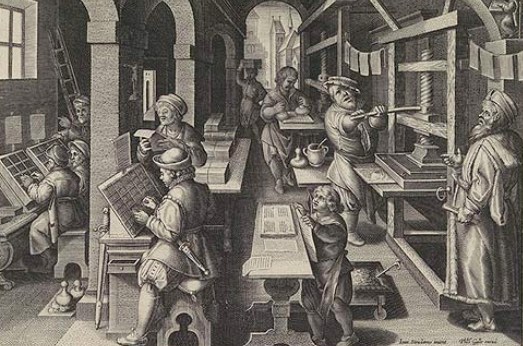
As you can tell from my previous blog posts, I am intrigued by the idea of printing and how it affected society today. I'm grateful that Johannes Gutenberg invented the printing press during the Renaissance Era, because it changed how people back then and even still today receive and distribute knowledge. Without it, the education system, the legal system and many other aspects of society today would be completely different and would most likely be more oral based and involve a great deal of memorization.

To show my appreciation for print, distribution and dissemination during the Reniassance Era, I decided to do some investigating on this subject. I searched the Harold B. Lee Library and made my way to the fifth floor to scope out some books on the topic.

Thursday, November 24, 2011

Print and its Effects on Medical Advances

(So according to some suggestions by our professor I'm adding this note.  This post is part of my ANNOTATED BIBLIOGRAPHY assignment.  The bibliography is below the page break and is about THE EFFECTS OF PRINT ON MEDICAL KNOWLEDGE.)

*     *     *

Venturing into the strange world physical research in a library with actual books, moving bookshelves, and code-like numbers on the sides of these books can be a pretty scary task for today's college student.  I probably do about one or two research assignments in the library each semester, but I swear that each time a have I have to again overcome my fear of doing research and actual physical movement at once.  I also have to relearn how to look stuff up there every time I try to use the numbering system, which reminds me of the library card song from Arthur - An integral part of my childhood.  Please enjoy:


"Who's Dewey?": one of those questions we will never know the answer to. . . or maybe we could look him up on wikipedia.  Anyway, after getting reacquainted with the cataloguing system again, (which is actually not the Dewey Decimal System in the HBLL) I started to search for books that teach about how the printing press affected medicine.  So here it is:

Friday, November 18, 2011

King James Bible Exhibit.

This past week I visited the Life and Legacy of the King James Bible exhibit in the Harold B. Lee Library. In his most recent blog post, Will analyzed the whole exhibit and explained the pros and cons of translating the Bible. (I encourage everyone to read his post). However, I personally found it interesting how the translated King James Bible has affected society, especially American society from the 1800s to date.
King James I of England ordered that a uniform translation of the Bible would begin in 1604. The translation was complete in 1611. "Cultural, religious, and political forces over the next half century of this version's existence finally contrived to make the King James Bible the only used in England. The King James Bible traveled with the British as they colonized the world" (King James Bible exhibit pamphlet). This means that as people began to come to America for political and religious freedom, they brought the King James Bible with them.

"Publicly and privately, the King James Bible was read, heard, and studied by countless individuals in English-speaking countries and territories, and its language and style shaped their own thoughts and writings. Critics note the influence of the King James Bible—not just the stories, but the syntax and style—in works by many great orators and authors of the 18th, 19th and early 20th centuries, especially in the United States" (Transforming the Word).

Famous Americans throughout history such as Abraham Lincoln, Herman Melville and John Steinbeck were influenced greatly by the Bible. All used imagery, repetition or allusions to the King James version of the Bible (Transforming the Word). This, in turn, influenced the political and social aspects of American society as people read their novels and followed politics closely.


Religiously, the King James Bible was, and still is, used by many of the Protestant churches that flourished in America. The Church of Jesus Christ of Latter-day Saints, which is not considered a branch of Protestantism, uses the King James Bible as well. In fact, Joseph Smith translated portions of the King James Bible in the 1800s to help clarify the meanings of some passages. In addition, there are cross references in the Book of Mormon to the King James Bible in order to make studying and feasting upon the scriptures much easier for Latter-day Saints. Today, the King James Bible is the most popular Bible used in America by multiple religions. This is significant in that America was founded on the belief of religious freedom. With most religions using and basing their faith off of the King James Bible, it seems that even today is one of the most influential works printed and read.

Thursday, November 17, 2011

Corrected and Improved by the Author

 Today I took a visit to the Crandall Historical Printing Museum.  I wasn't really sure what I would find there so I just drove over and walked inside.  No one was at the desk so I wandered inside and I found a group of elementary school or middle school students inside on a field trip.  They must have been an LDS charter school or something and were listening to a presentation of how the first copies of the Book of Mormon were printed using the old printing presses and process.  I slipped into the back of the group and listened a bit.  The presentation was obviously more of an overview than technically historical so I wandered around a bit as I listened, examining the old presses and prints that the museum workers have made on them.  The tour guide said something that really caught my attention though.  He said that With the 37 signatures and setting the type and hand sewing the books together, the 5000 original copies of the Book of Mormon should have taken 2 years to produce working at full speed full time.  A miracle occurred and the books were printed in only 7 months by (if I heard him correctly) fairly inexperienced printers.

Tuesday, November 15, 2011

To Fold or Not to Fold? That is the Publisher's Question

If you have studied Shakespeare even a little bit, you should have been exposed to the idea of folios and quartos, not to mention octavos or thirty-twomo's.  If not you are about to be educated.

A thirty-twomo (its a book size :-)

Friday, November 11, 2011

Printing and Digital Media.

The printing press, which I talked about in a previous blog post, made it possible for literature to be mass produced at a quicker rate that was less expensive. It provided the common people of the Renaissance Era the opportunity to own books and read what great scholars where discovering and learning all over the world. But that's just it...printing allowed GREAT SCHOLARS and WELL KNOWN FIGURES to promote their ideas.

Gutenberg Press
People like John Locke, Martin Luther and Voltaire were able to express their revolutionary ideas. John Locke, for example, promoted a more liberal philosophy which is considered a "keystone" to American government and other Western countries' governments. Martin Luther was considered the father of the Protestant Reformation, which taught people to break away from the traditional teachings of the Roman Catholic Church and taught that it was through the grace of God and one's own faith that one could be saved. Voltaire, another prominent figure (writer) of the Renaissance Era who advocated freedom of religion, free trade, and separation of church and state.