

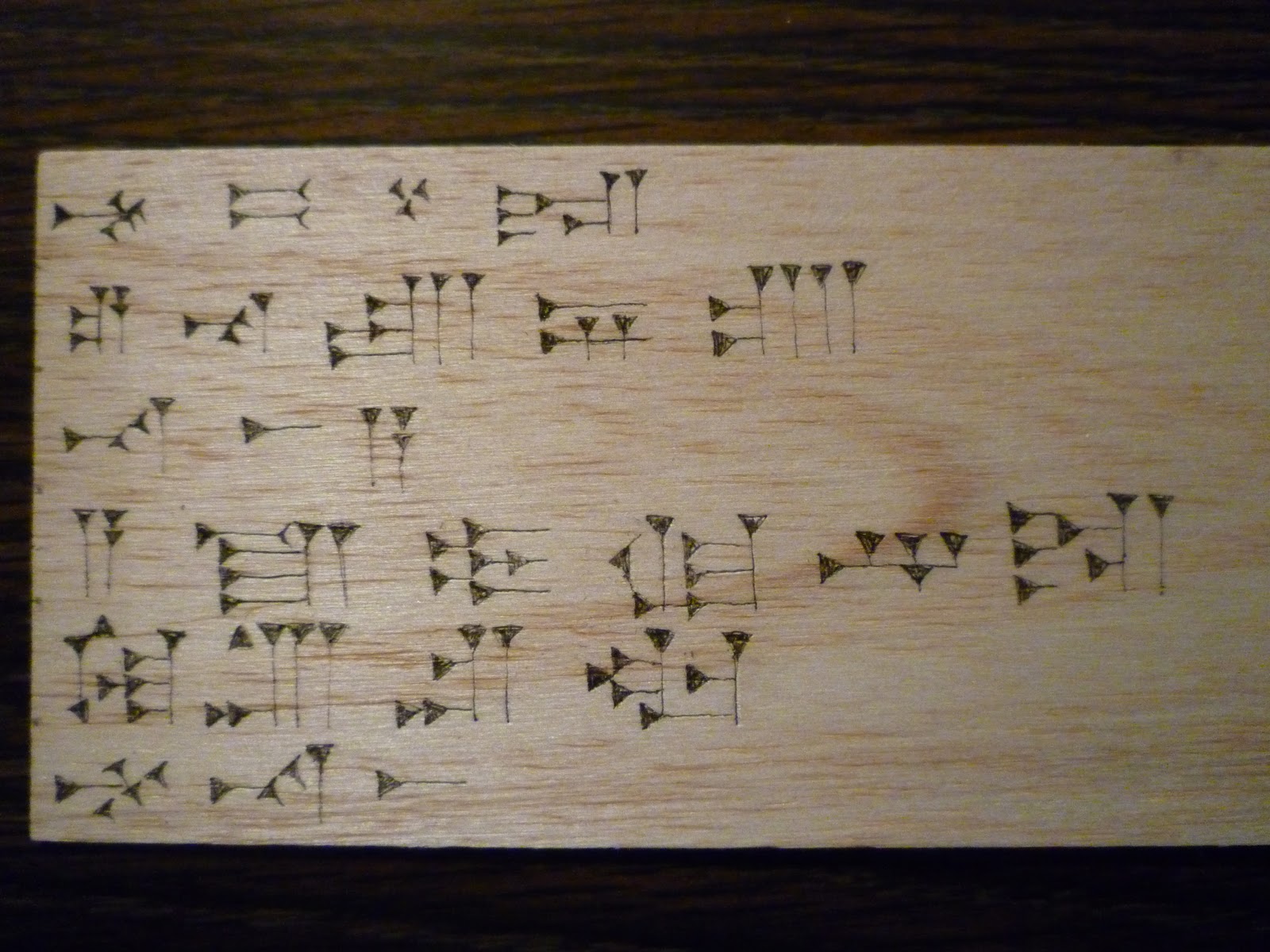
So the process after receiving our Akkadian clay tablet was a lot harder than anyone expected. A number of us started to try to find the characters and look up which syllables they represented independently. Luckily Erin was able to visit with a professor who gave her some more direction. It turns out that not all the characters were actually correct - revealing to us why it was no one could find a few of them. After translating all we could, we had to find the original document that the other group used in order fill in the gaps and get it translated to English ---------->
 I again was in charge of the Mayan translation which was difficult of course, because 1-Mayan is not completely deciphered yet 2: I am still shady on Mayan syntax and grammar 3: There are not equivalent words in Mayan, English, and Akkadian. This is something that I have realized as I have volunteered as a Spanish medical translator too. Sometimes things really are just "lost in translation," whether it is because of translator error, or meanings difficult to express in another language, copy errors, bias of a translator, or just plain laziness in translation. It is not an easy task.
This was a difficult assignment for MANY reasons but I really liked the idea of it and had fun learning about these mayan glyphs. I think that it really helped me understand how knowledge is passed on and how that really has changed from the age of writing to typing to the pixel. I also think this project helped us think creatively in order to solve problems that were completely unfamiliar to us.


