Showing posts with label Printing Press. Show all posts

Monday, November 28, 2011

Print Distribution and Dissemination.

As you can tell from my previous blog posts, I am intrigued by the idea of printing and how it affected society today. I'm grateful that Johannes Gutenberg invented the printing press during the Renaissance Era, because it changed how people back then and even still today receive and distribute knowledge. Without it, the education system, the legal system and many other aspects of society today would be completely different and would most likely be more oral based and involve a great deal of memorization.

To show my appreciation for print, distribution and dissemination during the Reniassance Era, I decided to do some investigating on this subject. I searched the Harold B. Lee Library and made my way to the fifth floor to scope out some books on the topic.

Visiting the Crandall Historical Printing Museum


A few weeks ago, I rode my bike down to the Crandall Historical Printing Museum. It wasn’t my first visit to the museum, but in fulfilling the “field trip” requirement for our class unit on printing, I decided to go back. I thought it would be interesting to see what my impressions of the museum were this time around. Here are a few of the thoughts I left with:

Thursday, November 24, 2011

Print and its Effects on Medical Advances

(So according to some suggestions by our professor I'm adding this note.  This post is part of my ANNOTATED BIBLIOGRAPHY assignment.  The bibliography is below the page break and is about THE EFFECTS OF PRINT ON MEDICAL KNOWLEDGE.)

*     *     *

Venturing into the strange world physical research in a library with actual books, moving bookshelves, and code-like numbers on the sides of these books can be a pretty scary task for today's college student.  I probably do about one or two research assignments in the library each semester, but I swear that each time a have I have to again overcome my fear of doing research and actual physical movement at once.  I also have to relearn how to look stuff up there every time I try to use the numbering system, which reminds me of the library card song from Arthur - An integral part of my childhood.  Please enjoy:


"Who's Dewey?": one of those questions we will never know the answer to. . . or maybe we could look him up on wikipedia.  Anyway, after getting reacquainted with the cataloguing system again, (which is actually not the Dewey Decimal System in the HBLL) I started to search for books that teach about how the printing press affected medicine.  So here it is:

Thursday, November 17, 2011

Corrected and Improved by the Author

 Today I took a visit to the Crandall Historical Printing Museum.  I wasn't really sure what I would find there so I just drove over and walked inside.  No one was at the desk so I wandered inside and I found a group of elementary school or middle school students inside on a field trip.  They must have been an LDS charter school or something and were listening to a presentation of how the first copies of the Book of Mormon were printed using the old printing presses and process.  I slipped into the back of the group and listened a bit.  The presentation was obviously more of an overview than technically historical so I wandered around a bit as I listened, examining the old presses and prints that the museum workers have made on them.  The tour guide said something that really caught my attention though.  He said that With the 37 signatures and setting the type and hand sewing the books together, the 5000 original copies of the Book of Mormon should have taken 2 years to produce working at full speed full time.  A miracle occurred and the books were printed in only 7 months by (if I heard him correctly) fairly inexperienced printers.

Friday, November 11, 2011

Printing and Digital Media.

The printing press, which I talked about in a previous blog post, made it possible for literature to be mass produced at a quicker rate that was less expensive. It provided the common people of the Renaissance Era the opportunity to own books and read what great scholars where discovering and learning all over the world. But that's just it...printing allowed GREAT SCHOLARS and WELL KNOWN FIGURES to promote their ideas.

Gutenberg Press
People like John Locke, Martin Luther and Voltaire were able to express their revolutionary ideas. John Locke, for example, promoted a more liberal philosophy which is considered a "keystone" to American government and other Western countries' governments. Martin Luther was considered the father of the Protestant Reformation, which taught people to break away from the traditional teachings of the Roman Catholic Church and taught that it was through the grace of God and one's own faith that one could be saved. Voltaire, another prominent figure (writer) of the Renaissance Era who advocated freedom of religion, free trade, and separation of church and state. 

Thursday, November 10, 2011

Scripts and Fonts

I think that this week for everyone is a pretty crazy one.  I am going to do you all a favor by trying to keep this short (and to do myself a favor too).  Since we just barely switched over from written knowledge to print, I thought I'd make sort of a bridge post about the transition and its effects on the way we write.

Compare these two writing samples.
A sample written script.

Sample font from Gutenberg's Bible

Obviously not all written things are that hard to read and not all print was that detailed and beautiful, but that is just an example.

A few weeks ago I got a random email from FamilySearch about indexing.  (Family Search indexing is a way that anyone can give service by transcribing old written documents into electronic type so that they are readily searchable for people studying their genealogy.)  The email linked me to a few sites about paleography which got me thinking about the differences between our letters today and the letters of 'back then' and the way that print changed that.

Friday, October 28, 2011

Printing.

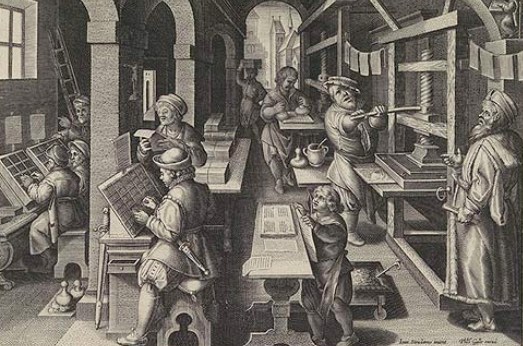
The first printing press was invented during the Renaissance era around 1440 by Johannes Gutenberg of Mainz. This printing press used a movable metal type which was set to print one page of a book at a time. Oil-based inks were used to coat the type. After so many copies were made of one page, the type would be cleaned and rearranged to form the next page, until all of the pages of a book were complete.
Johannes Gutenberg
The metal type used was more durable than woodblocking
(which was also used for printing images), as it was molded of metal and would not crack or break as easily. The type was also more uniform and easily read, unlike written writing which was often times corrected by multiple people with different hand-writings. The type could also be adjusted or created to be more aesthetically pleasing and appealing to the eye. Often, art was also inserted into books through printing as well. Oil-based ink was used because it was long-lasting and would not fade as much.

Because books and other written works were able to be printed quicker and through mass production, the price of books became cheaper and became more available to the common people. The most famous of these mass produced texts, the Bible (or the Gutenberg Bible), was most commonly read more than any other book during this time.


Gutenberg Press
With this new found way of mass producing written works, the printing press popularized all throughout Europe within only a few decades. This allowed for scientists, religious leaders, and other scholars to circulate their ideas and discoveries quicker and on a much broader scale that was available to the middle class as well.

This method of printing and distributing of knowledge continued until the 19th century when the hand-operated Gutenberg press was replaced by the steam-powered rotary press and, eventually, computer printers.