Technology inherently replaces the obsolete to a varying degree. One should view different knowledge mediums pseudo technology in of themselves. Each medium can be thought of as an invention or revolution in the way humans think. While no knowledge medium is ever completely eradicated, history shows that each newly invented medium replaces the previous medium as the dominate way to communicate knowledge.
Showing posts with label Written Knowledge. Show all posts
Showing posts with label Written Knowledge. Show all posts
Wednesday, December 14, 2011

Tuesday, December 13, 2011
Final Post: Community and Communication
This morning we gathered in small groups to discuss each unit covered in the course (folk knowledge, oral knowledge, written knowledge, print knowledge). I enjoyed getting some new perspectives on my thoughts on the connection between the mode of communication and the type of community formed. The last rotation, focused on print knowledge with Brianne and Montana, was particularly helpful. In my notes for the final, I mentioned my impression that studying different mechanisms of communicating knowledge affected how our group interacted; discussing with my classmates helped my expand that idea to the cultures that we studied in the course. The broader the reach of the a type of knowledge, the larger but less intimate community it forms.
Oral Knowledge: Spirituality and Religious Practice
Oral Knowledge: Spirituality and Religious Practice
Within history, oral knowledge has had a more powerful effect upon spirituality and religious practice than other types of knowledge. Word of mouth has been more influential upon religion, because it is considered a more sacred means of communicating and relaying knowledge, it is personable to religious followers, and it is a means of communication that has paved the way for other areas of knowledge.
Tuesday, November 15, 2011
Akkadian Cuneiform - the Hardest Language I Have Ever Tried to Learn!
For my Rosetta Stone project, I was in the Mesopotamian group (Phoenicia is in that area) and we had some difficulties with our language and writing form. I mostly worked with Catherine to create the first artifact, and so during the second part I took a back seat, and mostly worked as the liaison to the group that received our artifact. But the first artifact itself was hard enough.
To start with, one of our other group members had talked to a professor on campus that was fluent in Akkadian cuneiform, so he went and talked to him, and gave us a sheet of paper with the English phonetic syllables and the English translation of the Akkadian, but not the cuneiform. For that, he told us to go down to the Museum of Peoples and Cultures and look at the actual clay nail that it was written on. (Note: Akkadian is the language of the Babylonians around 2500 B.C., cuneiform is the script they used to write it down, and Babylonia was the civilization that Catherine studied.)
To start with, one of our other group members had talked to a professor on campus that was fluent in Akkadian cuneiform, so he went and talked to him, and gave us a sheet of paper with the English phonetic syllables and the English translation of the Akkadian, but not the cuneiform. For that, he told us to go down to the Museum of Peoples and Cultures and look at the actual clay nail that it was written on. (Note: Akkadian is the language of the Babylonians around 2500 B.C., cuneiform is the script they used to write it down, and Babylonia was the civilization that Catherine studied.)
To Fold or Not to Fold? That is the Publisher's Question
If you have studied Shakespeare even a little bit, you should have been exposed to the idea of folios and quartos, not to mention octavos or thirty-twomo's. If not you are about to be educated.
 |
| A thirty-twomo (its a book size :-) |
Tuesday, November 8, 2011
Marginalia: Facinating or Defacing?
Marginalia: marginal notes or embellishments (as in a book). Latin.
Love,
Webster
Love,
Webster
 |
| Marginalia of The Lion, The Witch and The Wardrobe |
Friday, November 4, 2011
Symbols and Codes.
We discussed in class a little bit yesterday the correlation between a literary system and a numeracy system. As soon as writing developed, written numbers were used to keep track of business transactions and other records. In fact, most artifacts that we have today are records of accounting.
 |
| The oldest tablet found in Europe, written in the Mycenaean Linear B System. It records business transactions. |
But can letters and numbers have other correlating purposes? Of course, they both can be used to create a code, or a system of secrecy or multiple representation in which certain words, letters, or numbers are assigned different meanings.
The Ancient Greeks, for example, actually used there letters as symbols of numbers. Their alphabet served a dual purpose. It communicated thoughts and ideas, but also stood as representation of a number in many cases. Today, we still use letters of the Greek alphabet to represent numbers which we plug into formulas (or mathematical codes) such as Alpha, Beta, Gamma, Phi and Pi.
Similarly, the Roman alphabet, or the Latin alphabet, which is the most recognized alphabet in the world today, evolved from a Western variety of the Greek alphabet. This alphabet, along with Arabic numerals, is the basis of what is perhaps the most common code today, Morse Code. This code is unique in that it can be used through almost any kind of medium; sound, written, visual.

Just for fun, I created my own code using numbers as letters. See if you can decipher what this says and you'll discover an interesting fact about me!
23...15.1...6.19.26.15.8.19.18...8.3...21.3.6.18.3.2...16...22.23.2.17.25.26.19.13...
Tuesday, November 1, 2011
Questions, With No Real Answers
So what does it mean to "write it down"? To save a piece of information by putting it in a book, on a sticky note, or in a planner? To write/(take) notes instead of just listening? To send a handwritten letter or card, as opposed to a store-bought one, or even an email? How does the significance of writing versus memorization compare in our time? How would it have compared in the time periods we are discussing?
I really didn't do much research for this post, but I am enjoying the thought experiment. "Critically" thinking about what we have learned about writing so far, and how it has changed our perspective on the world, and how it must have changed the ancients' perspectives. So I am basically answering the previous questions with my personal, educated opinions, and I want this post to open the blog to yours too.
I really didn't do much research for this post, but I am enjoying the thought experiment. "Critically" thinking about what we have learned about writing so far, and how it has changed our perspective on the world, and how it must have changed the ancients' perspectives. So I am basically answering the previous questions with my personal, educated opinions, and I want this post to open the blog to yours too.
Monday, October 31, 2011
Calligraphication
So as I posted earlier, I tried my hand at calligraphy, but without training I did not do a very good job. We decided as a group to go over to Alicia's house last Friday and she taught us all about inks, papers, nibs, scripts, and everything you could ever want to know about calligraphy. It turns out she's quite the expert. We documented the experience with photos so I could post it here.
Everyone can please add to this post or put their 2 cents about the experience in a comment.
Friday, October 28, 2011
Printing.
The first printing press was invented during the Renaissance era around 1440 by Johannes Gutenberg of Mainz. This printing press used a movable metal type which was set to print one page of a book at a time. Oil-based inks were used to coat the type. After so many copies were made of one page, the type would be cleaned and rearranged to form the next page, until all of the pages of a book were complete.
 |
| Johannes Gutenberg |
(which was also used for printing images), as it was molded of metal and would not crack or break as easily. The type was also more uniform and easily read, unlike written writing which was often times corrected by multiple people with different hand-writings. The type could also be adjusted or created to be more aesthetically pleasing and appealing to the eye. Often, art was also inserted into books through printing as well. Oil-based ink was used because it was long-lasting and would not fade as much.
Because books and other written works were able to be printed quicker and through mass production, the price of books became cheaper and became more available to the common people. The most famous of these mass produced texts, the Bible (or the Gutenberg Bible), was most commonly read more than any other book during this time.
 |
| Gutenberg Press |
With this new found way of mass producing written works, the printing press popularized all throughout Europe within only a few decades. This allowed for scientists, religious leaders, and other scholars to circulate their ideas and discoveries quicker and on a much broader scale that was available to the middle class as well.
This method of printing and distributing of knowledge continued until the 19th century when the hand-operated Gutenberg press was replaced by the steam-powered rotary press and, eventually, computer printers.
Thursday, October 27, 2011
Chicken ScratchERS
Yesterday, I was doing some research on the internet about different forms of writing. I realized that everyone seems to have their own sort of writing utensil that they like to use. Personally if it is not a Cristal Bic* (preferably black) or at least Bic* mechanical pencil, I am just not going to be a happy writer. Well this got me thinking about how much we've seen about writing character systems and what we write on, but we hadn't looked a lot into what we write with. So I decided to compile a short history of writing utensils leading up to the renaissance.

Chicken Scratch
All right, so today I am going to put up two posts and this one will be short. I was thinking about what I would blog about this week when I realized that my room mate's girlfriend had a set of calligraphy pens. I figured that there would be nothing like a hands on experience with something that most of us are completely unfamiliar with today. I started messing around and wrote this page (albeit somewhat sloppily) just to try my hand at writing with the metal tipped ink pen.


Wednesday, October 26, 2011
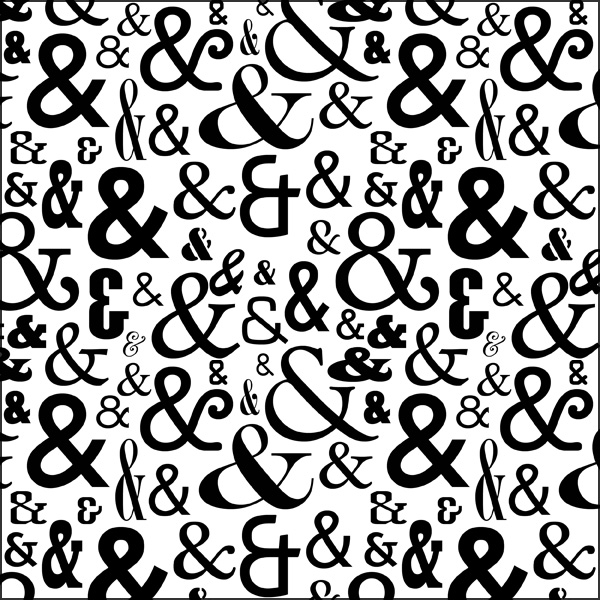
&&&&&&&&&&&&&&&&&&&&&&&&&&&&&&&&&&&&&&&&&&&&&&&&&&&&
This week, I decided that rather than examining written knowledge on a
large scale, I’d focus on one very specific piece of our written knowledge
tradition: the ampersand. In case you didn’t know, “ampersand” is the name for
the “and” symbol that looks like this:
Tuesday, October 25, 2011
A Roman Alphabet and Arabic Numerals
Sorry to break the trend, but I am going to step away from the idea of mediums ... and into the realm of numbers.
I don't know if I have said this previously, but I love the etymology of words, and knowing the origins of things and what that can teach us about the thing itself, whether it is whole words or letters or numerical symbols. That's partly why I was so happy I got the Phoenician civilization, because it had the first alphabet (basically). But as I have continued to study the alphabet and where ours came from (if you can't find "Letter Perfect" at the library, it is because I have it :-), the thought occurred to me: if we use the Roman alphabet, why don't we use Roman numerals too? Where did the Arabic ones come from?
 |
| The Evolution of Numbers |
I don't know if I have said this previously, but I love the etymology of words, and knowing the origins of things and what that can teach us about the thing itself, whether it is whole words or letters or numerical symbols. That's partly why I was so happy I got the Phoenician civilization, because it had the first alphabet (basically). But as I have continued to study the alphabet and where ours came from (if you can't find "Letter Perfect" at the library, it is because I have it :-), the thought occurred to me: if we use the Roman alphabet, why don't we use Roman numerals too? Where did the Arabic ones come from?
Friday, October 21, 2011
European Writing and Art.
Europe is famous for it's philosophy and art. Both are ways in which knowledge and ideas can be passed down and preserved.
 | |||||
| School of Athens painting by Raphael. |
Although technically not an apprenticeship, the teachings of philosophers such as Socrates, Plato and Aristotle (as I mentioned in my previous post) were passed on orally throughout the Greek Civilization. However, the development of various writing systems allowed their philosophies to be written and made available to many others, which lead them to be understood by many others. As a result of being written down, thoughts were preserved not only for the use of those who lived during the Renaissance era, but for the many generations of people who lived after the Renaissance era. Written forms of thoughts also made it easier for one to be taught or tutored by others, since philosophies and actual facts could be referenced without having to be memorized.
 |
| Michelangelo's Pieta. |
Italian artists also continued their trade mainly through relatives or close family friends. Michelangelo, for example, was sent off at a young age to live with a wet nurse who was married to a stone cutter. At a very young age, Michelangelo began to develop a love for stone and as he became older he was taught by the stone cutter how to handle various types of stone. Now, years later, Michelangelo is known for his many famous sculptings such as the "Pieta," "Madonna of the Stairs" and "David."
These sculptures are now records, different than that of a written record, which help us to determine the thoughts and ideologies that Renaissance artists and people in general had about religion and philosophy through the means of emotion.
Through both written philosophy and preserved works of art, we have been able to unravel the ideas and thoughts that Ancient scholars and artists had which have greatly impacted how we, as a Western culture, view the world. How do art and writing, which are both expressive and informative forms of preservation, differ in the ways of how we understand Ancient cultures'? What are some pros and cons to each method of preserving ideas and passing along knowledge?
Thursday, October 20, 2011
Scraping Metal
 |
| This golden disk found in Peru is an contains an inscription of a calendar system. |
"Who didn't write on metal plates?"
Wednesday, October 19, 2011
Etruscan Knowledge Institutions
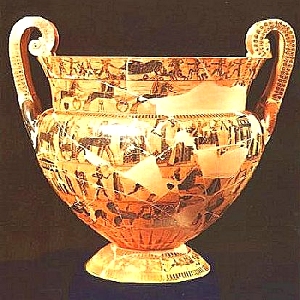
During our unit on oral knowledge, I discussed knowledge institutions within the Etruscan civilization here. Last week, I talked about Etruscan writing and language here. This week, my assignment is to talk about knowledge institutions within the Etruscan civilization, as a part of our unit on written knowledge.
Tuesday, October 18, 2011
The Origins of the Alphabet, Phoenician Style
In the beginning, there were Egyptian hieroglyphs and Mesopotamian cuneiform. From that sprung the 22-letter Phoenician alphabet that is the Mother of every other alphabetic system known to man.

Friday, October 14, 2011
The Linear B Script.
Ancient Greek civilizations are famous for their developments in language and communication. One such civilization is the Mycenaean civilization, which I have researched about in my last couple of blog posts. Originally, only those who held religious authority or political power were taught how to orate properly. It wasn't until philosophers, Socrates and Plato, had popularized speech, that the common Mycenaean people began to use oration as an authoritative and scholastic means of communication. However, Aristotle, a student of Plato, argued that speech was not the only means or even the most important mean of communication. He believed the written language was.
 |
| Basic Linear B syllabary. |
Thursday, October 13, 2011
Sitting on the Fence . . . For Thousands of Years
As we began this unit on written knowledge, I was rather excited. I love hand writing and different symbols and everything that has to do with writing. The power of the written word is something I have loved ever since I learned to read. I suddenly became disappointed when I realized that I needed to talk about writing within the Hopi culture, mostly because they do not have an alphabet. I guess that kind of puts a damper on writing if you don't have an alphabet. Luckily as I have studied out the topic, I have realized that the Hopi language and people can give us a lot of cool clues as to how writing systems are developed because they stayed with a transitionary step to developing writing systems - the pictograph.
 |
| The famous "Hopi Prophecy Rock" - Said to depict the consequences of not living in harmony with the earth. Says that if we don't there will be a WWIII-like cataclysmic event. |
Subscribe to:
Comments (Atom)