On Tuesday, we ended our Honors 201
class with a salon-style discussion about the different types of knowledge
we’ve examined over the course of the semester: folk, oral, written, and
printed knowledge. I left the discussion with one overwhelming impression: you
just can’t look at them that way. I understand that while none of these types
of knowledge stands alone, they were separated this way by our professors in
order to examine them as manageable units—it’s an artificial separation, but we
needed to separate them somehow, and this works. However, what really struck me
during our class discussions this week was that the artificiality of these
separations makes it nearly impossibly to compare the effects or relative power
and significance of one type of knowledge over another.
Showing posts with label Lauren Noorda. Show all posts
Showing posts with label Lauren Noorda. Show all posts
Thursday, December 15, 2011

Monday, December 5, 2011
Patronage as Censorship, draft 1
I don't think it's possible to upload a document as such directly to this blog, and I didn't really want to have to reformat my paper so that it would work here, so here is a link to my first draft, in Google Doc form.
See it here.
If you have a chance, look over it. Let me know what you think.
See it here.
If you have a chance, look over it. Let me know what you think.
Keeping it Short
I'm about done with the first draft of my paper, which I'm writing about Elizabethan patronage of Shakespeare's plays as an indirect vehicle for censorship, and I've been a little bit surprised by the hardest aspect of this paper for me: keeping it short.
Papers that are 15-20 pages in length are pretty standard for my majors and my place in them. Final papers are often a bit longer, and econometric analyses or behavioral experiments can have lots of appendices that really add to the stack. Last week, I turned in an econometrics paper that was a new record for me: 76 pages. (That's a lot of money for printing.) So keeping this paper to a measly three or four pages has been a bit different.
I've noticed that I have needed to scale back my writing style and leave out some pieces of the logical progression between thoughts, or at least to simplify the overall argument. I've also found myself citing fewer sources and providing less evidence for my argument. It's a weird feeling.
Not that I'm complaining.
Papers that are 15-20 pages in length are pretty standard for my majors and my place in them. Final papers are often a bit longer, and econometric analyses or behavioral experiments can have lots of appendices that really add to the stack. Last week, I turned in an econometrics paper that was a new record for me: 76 pages. (That's a lot of money for printing.) So keeping this paper to a measly three or four pages has been a bit different.
I've noticed that I have needed to scale back my writing style and leave out some pieces of the logical progression between thoughts, or at least to simplify the overall argument. I've also found myself citing fewer sources and providing less evidence for my argument. It's a weird feeling.
Not that I'm complaining.
Monday, November 28, 2011
Annotated Bibliography: Censorship in Elizabethan England
For
my annotated bibliography assignment, I decided to learn a little bit about censorship
in Elizabethan England. Censorship is a topic that I’m very interested in, but
it’s such a huge topic that I wouldn’t have known where to start if I was just
researching anything to do with it, so I wanted to narrow it down somehow. The
Tudors made for some of my favorite English royal drama, Elizabeth I is one of
my favorite people, and Shakespeare was producing his work during the
Elizabethan and Jacobean (Stuart) Eras, so I decided to learn everything I
could about censorship in the Elizabethan Era. There weren’t very many books on
that specific topic, but I was able to find several books in the library in
which the issue was at least addressed on some level, and I used interlibrary
loan to have a few other books sent over.
Visiting the Crandall Historical Printing Museum

Wednesday, October 26, 2011
&&&&&&&&&&&&&&&&&&&&&&&&&&&&&&&&&&&&&&&&&&&&&&&&&&&&
This week, I decided that rather than examining written knowledge on a
large scale, I’d focus on one very specific piece of our written knowledge
tradition: the ampersand. In case you didn’t know, “ampersand” is the name for
the “and” symbol that looks like this:

Wednesday, October 19, 2011
Etruscan Knowledge Institutions
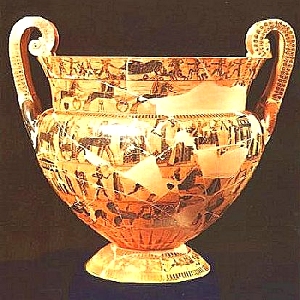
During our unit on oral knowledge, I discussed knowledge institutions within the Etruscan civilization here. Last week, I talked about Etruscan writing and language here. This week, my assignment is to talk about knowledge institutions within the Etruscan civilization, as a part of our unit on written knowledge.
Wednesday, October 12, 2011
Etruscan Writing and Language
The writing system of the Etruscans is highly correlated with other Indo-European systems (particularly Greek), but the language of the Etruscans is quite the opposite. Linguists have a hard time placing it within a language family, and it seems fairly isolated.
Wednesday, October 5, 2011
Oral Education and the Etruscan World, part 2
Last week, I posted about education in the Etruscan world, based on my reading on the topic. Earlier today, I posted a bit about the process it has been
to try and contact someone for an oral interview this week. It was really a lot
more work than I planned to put into this class. However, something finally
came through!
Stay Tuned. Here's Why.
This week, our assignment was to conduct an oral interview
with someone who knew something about the civilization to which we were
assigned and the aspect of it to which our group was assigned. For me, this
meant conducting an oral interview with someone who is an expert on education
within the Etruscan Civilization. How do you do such a thing? That is a very
good question. Let me tell you.
Friday, September 30, 2011
Just one of those weird things we do.
Tomorrow morning, about half a million people will crowd into university testing halls and take the LSAT, the Law School Admissions Test. (I'm one of them.) But it got me thinking--the whole standardized test education system is kind of a unique institution. We do it a number of times in our educational careers You take the SAT and ACT when you are graduating from high school and starting college, the GMAT or GRE or LSAT or MCAT, depending on what you want to do after you finish your undergraduate degree. And those of us who grew up going to public schools took all kinds of standardized tests, from the time we were in the first grade.
 It makes sense, that we use this type of system in order to compare what is happening in educational systems across a very large country, but still, it seems like one kind of interesting aspect of the knowledge institution we are a part of. There's not really anything oral about the LSAT or other standardized tests, but the fact that our group was specifically assigned to examine education institutions this week made me think about it differently than I previously had. I wonder where it came from and whether or not any other civilizations have employed a similar one.
Wednesday, September 28, 2011
When is good, part 2
In this post, I asked everyone to use the When Is Good? link to fill in your schedule. As of now (Wednesday afternoon), only one person has yet to do so, but already, there is not a single time in the next two weeks that works for all of us.
It looks like we're going to need to go to plan B. In class, we talked about trying to get a screen recording program to work. However, let's talk about this. Even if we use a screen recording program, we still need a time when all of us are available, and it really just looks like that isn't going to happen.
What do you guys think?
It looks like we're going to need to go to plan B. In class, we talked about trying to get a screen recording program to work. However, let's talk about this. Even if we use a screen recording program, we still need a time when all of us are available, and it really just looks like that isn't going to happen.
What do you guys think?
Oral Education in the Etruscan World
The Etruscan Civilization flourished in what is now Central Italy
from about 800 to 264 BC. While evidence would suggest that the Etruscans were
highly educated and productive in their scholarship, almost no evidence remains
of that scholarship in the form of texts or records. However, there is some
evidence that the Etruscans employed such practices as haruspicy and taught and
learned in special institutes, kind of like universities.

Tuesday, September 27, 2011
When is good?
Okay, guys. We need to figure out a time when we can meet to make our video conversation for this unit. I realized that I don't actually have all of your email addresses (how did that happen?), so I'm posting the link here. I'm assuming that no one who isn't one of us in Group 6 will be interested in when we're available to meet. All you have to do is click on the link below, and it will take you to a website where you will click on all of the boxes for times in which you are available. Everyone do this as soon as you get a chance, because then we can figure out a good time right away.
http://whenisgood.net/g3ycqyt
Thanks everyone!
http://whenisgood.net/g3ycqyt
Thanks everyone!
Wednesday, September 21, 2011
Saturday, September 17, 2011
I nearly died in completing this assignment.
(I'm very sorry about the late post, everyone. I guess what happened was that for some reason with all the videos and pictures I had in here, the schedule feature didn't work the way it was supposed to. I've put the text up now, so you can at least see something, but I can't get anything to upload at the moment, and I'll have to try to put the pictures and videos back in when I can go find a better internet connection. Sorry for the inconvenience; I guess this is what I get for taking a class that forces me to learn a whole new medium.)
I’m pretty good at a lot of things. Maybe that’s not particularly humble of me to say, but it’s true. However, I am not good at everything. This week is proof.
I’m pretty good at a lot of things. Maybe that’s not particularly humble of me to say, but it’s true. However, I am not good at everything. This week is proof.
I enlisted my 15-year-old brother, Bennett, to teach me
something about an area of folk knowledge I had never previously attempted:
break dancing.

Wednesday, September 14, 2011
Belay on!

I spent several hours today
teaching an old roommate of mine to rock climb at The Quarry, the indoor
climbing gym here in Provo. At first, I figured that this would count as folk
knowledge because it is something you learn from other people rather than from
textbooks or internet articles—you learn by doing and watching and feeling it
out. You get instructions from people who are better than you are, but the
instructions tend to be things like, “Stand more on your legs and less on your hands,” or “Make it a
little less, well, like that”—instructions that make little sense without a
shared physical context. After spending the day teaching Lisa to climb, I still think it counts as folk knowledge,
and I recognized some aspects of it that I hadn’t previously thought of as folk
knowledge at all.
This way, please.

At first glance, it’s a pile of rocks. Hardly noticeable.
Could have been put there by mistake.
At second glance, it might be more.
And if you’ve just spent four hours wandering in the
direction that you hope is south-south-east, it’s a tremendous comfort.
Those piles of rocks are called cairns, and though they are
still used today (I can attest to this from my own backpacking experience),
they have been used for centuries all over Europe, North Africa, Asia, and the
Americas. I specifically want to talk about the use of cairns in Europe.
Wednesday, September 7, 2011
We're food folk.
(Sorry guys, this is a
long post. I promise I’ll make my next few posts extra pithy to make up for
it.)

Subscribe to:
Comments (Atom)