This morning we gathered in small groups to discuss each unit covered in the course (folk knowledge, oral knowledge, written knowledge, print knowledge). I enjoyed getting some new perspectives on my thoughts on the connection between the mode of communication and the type of community formed. The last rotation, focused on print knowledge with Brianne and Montana, was particularly helpful. In my notes for the final, I mentioned my impression that studying different mechanisms of communicating knowledge affected how our group interacted; discussing with my classmates helped my expand that idea to the cultures that we studied in the course. The broader the reach of the a type of knowledge, the larger but less intimate community it forms.
Showing posts with label Alicia Cutler. Show all posts
Showing posts with label Alicia Cutler. Show all posts
Tuesday, December 13, 2011

Saturday, December 10, 2011
Notes on the semester
Ok So I thought I would get this going so we can have some ideas start flowing. I have this same table as a google doc so you can add or subtract from it.
Thursday, December 8, 2011
Retrospective on Spelling Paper
Having completed my final paper on spelling, I wanted to reflect a bit on my experience writing and polishing it.
Tuesday, December 6, 2011
Draft. Spelling and Renaissance
So I made some changes after today. Thanks for your help, especially Morgan.
I got some mixed feed back on how well I support my thesis. Your feedback on that and the flow would be appreciated
I got some mixed feed back on how well I support my thesis. Your feedback on that and the flow would be appreciated
Friday, December 2, 2011
Standardization of Spelling correlated with increased literacy
Ok so here is the topic I am interested in but I need you guys' help with a compelling thesis. I'm having trouble because the two events do seem to be correlated and I want to argue for causation but at best any evidence is circumstantial and the arguments rather circular.
How can I improve this statement?
The increase of literacy during the Renaissance made greater standardization of written language necessary to preserve meaning and understanding.
How can I improve this statement?
The increase of literacy during the Renaissance made greater standardization of written language necessary to preserve meaning and understanding.
Tuesday, November 29, 2011
Some interesting additions from Thanksgiving
So, for thanksgiving I got to go to my sister's wedding in Hong Kong. I notices several things that we had mentioned in previous blog posts or comments that I took pictures of and thought would be good to pass on to you all.
Saturday, November 19, 2011
Ah my old nemesis...Spelling
All my life I have been a horrible speller. Going to bed early on Christmas eve was never a problem because my family would always have a giant family Scrabble competition into the wee hours of the morning (thought still retiring before St Nick made an appearance). Who wants to be awake for that? When I learned that spelling and punctuation were not standardized in the distant past, I thought it was the most brilliant idea ever. But, like many of you, when I try to read old documents I shake my fists and shout to the heavens "had these people no sense of language?" Standardization is important for more universal understanding and this standardization has been facilitated and fostered by print and publishing.
I have compiled an annotated bibliography of useful sources on the standardization of spelling. I hope you find it informative.
I have compiled an annotated bibliography of useful sources on the standardization of spelling. I hope you find it informative.
Thursday, November 17, 2011
Influence of King James
Saturday, November 12, 2011
Bring out the Money

Friday, November 11, 2011
The Chinese gift
 |
| Qufu |
Our first thought was to have a quote from Confucius on rice paper. This would have been culturally significant because paper was invented in China (see Shuan's post on this). However, attempts at making rice paper were disastrous. Contrary to popular belief, at least my own and that of my group members, rice paper is not actually made out of rice. It is made out of rice straw or more modernly wood fiber,, mulberry, or bamboo. Also the arguably most famous Confucius artifact is actually the Confucius temple of Qufu. Confucius sayings are inscribed in stone.
Saturday, November 5, 2011
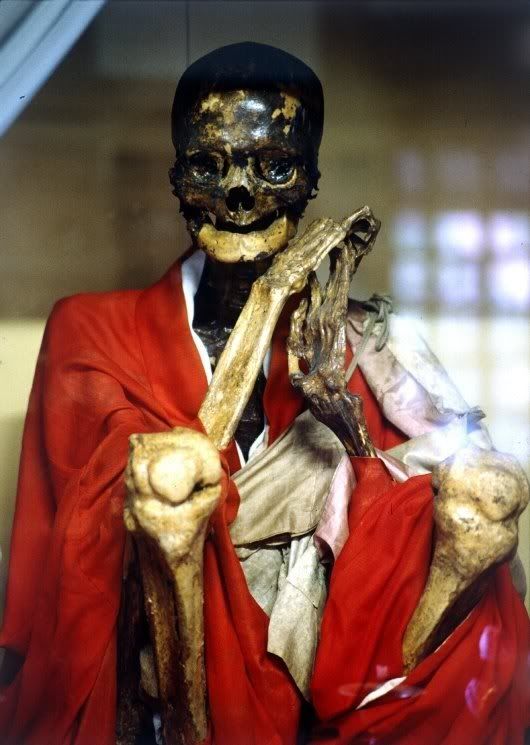
Monks, Meditation, and Mummies
Saturday, October 29, 2011
Arabic, hems, and the Virgin Mary
 |
| The Cambrai Madonna ~1340 Cathedrale de Cambrai, France notice the script on the sleeves and hood. |
Saturday, October 22, 2011
Choosing a Medium
I really enjoyed Mike's post about the metal plates and it started me wondering, is there a correlation between the medium used and the kind of document preserved? There are records from the Chinese preserved on wood, bamboo, silk, stone, paper, metal, and ceramic. I hypothesized that more domestic things would be preserved on ceramic, silk, and bamboo while the official institutional documents would be kept on paper, metal, and stone.
Wednesday, October 19, 2011
The beauty of the text
| Eusebian Canons from the Book of Kells |
 |
| Islamic Calligraphy |
Saturday, October 15, 2011
Khmer--the language this time
 |
| Elvish |
 |
| Khmer |
Tuesday, October 11, 2011
The Speech Expirience
Hey guys!
Great job reciting the speech today, I think it went great and it was definitely a memorable experience for me. I really enjoyed your comments and thoughts about it and thought it would be good to have a little platform to discuss it and build off each other's thoughts without having to run off to another class.
So to start it off...
I was most impressed by the unity created by all reciting together. I felt drawn closer to you and thought it was a good example of how ritual is an important part of creating a cohesive society.
Great job reciting the speech today, I think it went great and it was definitely a memorable experience for me. I really enjoyed your comments and thoughts about it and thought it would be good to have a little platform to discuss it and build off each other's thoughts without having to run off to another class.
So to start it off...
I was most impressed by the unity created by all reciting together. I felt drawn closer to you and thought it was a good example of how ritual is an important part of creating a cohesive society.
Saturday, October 8, 2011
Talking with the Past. My interview
For my interview I decided to carry on the theme I started in my first post on the Khmer, so I talked to a eastern studies Professor and to a survivor of the Khmer Rouge. For my brief summary of Cambodian History and the distinction between the Khmer and the Khmer Rouge click here.
Friday, October 7, 2011
Khmer History
Tuesday, October 4, 2011
Choral Recitation at gaming events

In class today, Mrs Burton came and presented on Choral Recitation. She is a Kindergarten teacher for special need children and taught us to all respond in unison to her questions. This is an effective way to teach things.
Obviously we are being clearly taught about our identity and how to spell C-O-U-G-A-R-S at sporting events. We therefore decided to classify them as important educational rituals.
Remember that as you visit your next football game!
Saturday, October 1, 2011
Aspara and the Churning Sea as performance
 Last week, I introduced the Khmer both as an ancient and a modern civilization. This week in class we have had rich discussions on myth and ritual. Our discussions reminded me of what I experienced visiting Cambodia in 2006. In preparation for the trip, we studied the myths that we would see repeatedly in the country, sort of like brushing up on the best hits of the Bible before touring cathedrals. We each were assigned several myths by my mother and subsequently relayed them for the enlightenment and education of our family. Once we arrived in Cambodia we found the myths everywhere and expressed much more eloquently than our home spun attempts.
Subscribe to:
Posts (Atom)