Showing posts with label Language. Show all posts

Wednesday, December 7, 2011

Learning is the Purpose... Or is it to Produce a Paper?

A master of comic rhyme in our time, I had to add him in. :-)
I have had a marvelous time learning all about Rhyming and its origins and development in the English language, but no matter how much I research, I can't seem to find the information I am looking for.  I can't find evidence to support the connections that I have hunches for, but I have found a lot of great information on the device of rhyme and its history throughout our society.  So I am afraid that I am going to write a thesis paper on what I have been learning about even though it doesn't necessarily correlate with the topic assigned to me. 

(I am building my argument... please keep reading...)

Tuesday, November 15, 2011

Akkadian Cuneiform - the Hardest Language I Have Ever Tried to Learn!

For my Rosetta Stone project, I was in the Mesopotamian group (Phoenicia is in that area) and we had some difficulties with our language and writing form.  I mostly worked with Catherine to create the first artifact, and so during the second part I took a back seat, and mostly worked as the liaison to the group that received our artifact.  But the first artifact itself was hard enough.

To start with, one of our other group members had talked to  a professor on campus that was fluent in Akkadian cuneiform, so he went and talked to him, and gave us a sheet of paper with the English phonetic syllables and the English translation of the Akkadian, but not the cuneiform.  For that, he told us to go down to the Museum of Peoples and Cultures and look at the actual clay nail that it was written on.  (Note: Akkadian is the language of the Babylonians around 2500 B.C., cuneiform is the script they used to write it down, and Babylonia was the civilization that Catherine studied.)


Tuesday, October 25, 2011

A Roman Alphabet and Arabic Numerals

Sorry to break the trend, but I am going to step away from the idea of mediums ... and into the realm of numbers.
The Evolution of Numbers


I don't know if I have said this previously, but I love the etymology of words, and knowing the origins of things and what that can teach us about the thing itself, whether it is whole words or letters or numerical symbols.  That's partly why I was so happy I got the Phoenician civilization, because it had the first alphabet (basically).  But as I have continued to study the alphabet and where ours came from (if you can't find "Letter Perfect" at the library, it is because I have it :-),  the thought occurred to me: if we use the Roman alphabet, why don't we use Roman numerals too?  Where did the Arabic ones come from?

Tuesday, October 18, 2011

The Origins of the Alphabet, Phoenician Style

In the beginning, there were Egyptian hieroglyphs and Mesopotamian cuneiform.  From that sprung the 22-letter Phoenician alphabet that is the Mother of every other alphabetic system known to man.


Saturday, October 15, 2011

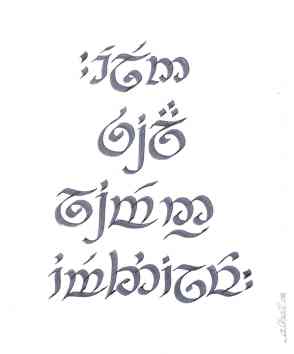
Khmer--the language this time

Elvish

Khmer
All growing up my family read Lord of the Rings by JRR Tolkien. I loved the story and the poetry and I loved the funny writing on the cover. How great was my surprise when, preparing to serve a mission for the LDS church, I encountered another missionary with the Bible in what appeared to be elvish. I had no idea that that language actually existed outside of Middle Earth. The missionary was going to Cambodia, not Middle Earth and the language was sadly not elvish but Khmer.

Thursday, October 13, 2011

Sitting on the Fence . . . For Thousands of Years

As we began this unit on written knowledge, I was rather excited.  I love hand writing and different symbols and everything that has to do with writing.  The power of the written word is something I have loved ever since I learned to read.  I suddenly became disappointed when I realized that I needed to talk about writing within the Hopi culture, mostly because they do not have an alphabet.  I guess that kind of puts a damper on writing if you don't have an alphabet.  Luckily as I have studied out the topic, I have realized that the Hopi language and people can give us a lot of cool clues as to how writing systems are developed because they stayed with a transitionary step to developing writing systems - the pictograph.
The famous "Hopi Prophecy Rock" - Said to depict
the consequences of not living in harmony
with the earth.  Says that if we don't there will be a
WWIII-like cataclysmic event. 

Wednesday, October 12, 2011

Etruscan Writing and Language


The writing system of the Etruscans is highly correlated with other Indo-European systems (particularly Greek), but the language of the Etruscans is quite the opposite. Linguists have a hard time placing it within a language family, and it seems fairly isolated.

Tuesday, October 11, 2011

#2 - Talking to an Academic Professional


During my research on the Phoenicians, I had the opportunity to explore several aspects of their culture and understanding. My interview with Professor Hamblin here at BYU confirmed a lot of my knowledge about the culture and their educational practices, and also brought to light a few of the details that I missed.  Overall, it was an interesting experience to meet with him, because I didn't know him at all, and he didn't know me, (I don't think he even learned my name) and the first time we talked I called him and asked if I could interview him (after doing my research on different professors' specialties).  So picture this, well, awkward setting, when I show up to speak to him during his office hours, though it is an appointment, and he is late because of a department staff meeting, and we finally sit down and I start asking questions and he gives answers and I take some very messy notes.  Below is basically what I learned from our discussion about the Phoenicians and their culture and oral tradition.  

Monday, October 10, 2011

Choices, Choices! #1 - Children’s Stories, From Africa to Mulberry Street


I hope that over the course of today, I will be able to add the other two blog posts that I hope to write, and you can pick which one you would like to comment on (though if you are feeling adventurous, you can comment to all three).  The other two will be a response to Dr. Burton's post on Syllabi and a commentary about my interview with an Ancient Near Eastern Studies Professor on the Phoenicians.  I am excited to write them and share my experiences, and I hope you enjoy reading.  

This past Friday, I did something atypical, and got a few strange looks because of it.  I attended the weekly Storytime at the Museum of Peoples and Cultures, and learned about the role of spiders in African and Caribbean folklore.  The other patrons at the event were mothers and grandmothers of toddlers, and of course the children themselves.  After the stories, we made our own spiders by tracing our hands without our thumbs and I helped a mother of 3 cut out her son’s paper hands.  It was a neat experience for me, and something I would like to repeat. 

Epic Performance


Imagine yourself high up in the mountains of present day Guatemala in a stone courtyard or plaza adorned with statues and figures carved from stone of fierce warriors, majestic kings and intelligent priests. The spoken words of a poet drift to your ears through the crisp air typical of the dry season. You listen attentively, relishing in the glorious detail of brave warriors and fierce battles. A part of you stirs in pride for your ancestors and rich cultural history. 

Tuesday, October 4, 2011

Library Experiences!!

Since we are doing oral knowledge, I woud like to tell a story with my post, that has to do with the Phoenicians, education, and unfortunate events.

A couple of days ago, I did a little research on the subject librarians at the Harold B. Lee Library (I learned that they existed through my honors writing class last year).  I found one that dealt with ancient history and the middle east, a Mr. Ryan Combs, and I thought 'perfect'! Yesterday, I got up the courage to go ask for help on my research about the Phoenicians and I am so glad I went.  I had to nervously stand out side his office for a few minutes after I realized that he was actually in there, studying the books on a nearby shelf and telling myself that I was silly not to ask for help.  Finally, I went and stood in the doorway and knocked lightly on the metal door frame. He looked up, turned off whatever game he was watching, and invited me in.  I stepped into the room and explained who I was and what I was looking for, all in a crazy rush, hoping to convey in as few words as possible the topics and assignment that I was trying to learn about.  He immediately turned back to the computer and started typing,  then almost absent-mindedly invited me to sit down.  I got out a pen and a notecard, and we started our discussion on the library's resources on the Phoenicians.


Monday, October 3, 2011

Preserve the Maya language!

Talking with Jose Canché was a bit surreal and very interesting. He is a member from one of the wards I served in on my mission in Los Angeles. I met him because he approached us asking us if we knew of a way he could get a Book of Mormon in Maya (officially classified by linguists as Maya- Yucatán). Yes, the same language passed down from the mysterious Ancient Mayan people. Jose is from Guatemala near the Yucatán peninsula in Mexico. He grew up speaking the language Maya. It isn't one of the 22 or so dialects found in Guatemala, rather it is simply Maya. 


map of the Ancient Mayan empire (green)

Monday, September 26, 2011

Popol Vuh and the Mayan language

The mysterious Mayan civilization was an advanced society that thrived between 1500BC and 900AD with its height around 250BC. Study of Mayan civilization remained untouched until the 1830s until we started discovering and deciphering glyphs from temples and other sites.