Showing posts with label Education. Show all posts
Showing posts with label Education. Show all posts
Tuesday, December 13, 2011
Practice makes Perfect
Ignoring the argument that really only PERFECT practice makes
perfect, I would like to apply this title phrase to our civilization
class. While striving to teach a class about four different
knowledge institutions, our professors have put into practice these
variant types of knowledge and created a perfect class. But
maybe only in the Greek sense of the word, how Christ
used it in Matthew, meaning to be complete, finished and fully
developed. We received a complete class, combining all the
types of knowledge together to create the ideal environment. By
bringing in guest speakers and lecturers, sending us off on field
trips, putting us in familial groups to learn together, and giving
atypical assignments we experienced the different types of knowledge,
instead of just learning about them.

Tuesday, November 29, 2011
The Story of the Dictionary (and my discovery of it)
The English Dictionary is the second most purchased and most used book behind the Bible only. Of course, there isn't just one dictionary or version of it, just like there are multiple versions of the Bible. Nevertheless, it is a popular book. But as one renown dictionary maker (also known as a lexicographer) said, it is meant to be browsed in, not read cover to cover.
There are several parts of language, and one of them is the actual words that are used, the vocabulary or the lexicon of a language. This is what a dictionary is meant to help with at its fundamental level: allow people to understand the lexicon of the language. That is why the first dictionaries were what we would call translation dictionaries and have two different languages in them, usually comparing Latin to some other language. Later the idea developed to define the vocabulary of one language, creating monolingual dictionaries. Then the development of ordering a dictionary in alphabetical order was introduced by Englishman Robert Cawdery, which became such an intrinsic part of dictionaries that books that don't do anything similar to a dictionary (define the lexicon) have acquired the title because of the alphabetical listing of their entries. Then, finally there was the idea of an American dictionary, because our version of English was different from the British, and that's how Merriam-Webster became a household name.
But really, you don't want to hear the story of the dictionary. You would much rather hear about my story in the library finding out about dictionaries. I dislike the fact that we have to put our annotated bibliography in alphabetical order, because that doesn't fit the order of the story, so I have numbered them in chronological order if you want a continuous story of discovery.
There are several parts of language, and one of them is the actual words that are used, the vocabulary or the lexicon of a language. This is what a dictionary is meant to help with at its fundamental level: allow people to understand the lexicon of the language. That is why the first dictionaries were what we would call translation dictionaries and have two different languages in them, usually comparing Latin to some other language. Later the idea developed to define the vocabulary of one language, creating monolingual dictionaries. Then the development of ordering a dictionary in alphabetical order was introduced by Englishman Robert Cawdery, which became such an intrinsic part of dictionaries that books that don't do anything similar to a dictionary (define the lexicon) have acquired the title because of the alphabetical listing of their entries. Then, finally there was the idea of an American dictionary, because our version of English was different from the British, and that's how Merriam-Webster became a household name.
But really, you don't want to hear the story of the dictionary. You would much rather hear about my story in the library finding out about dictionaries. I dislike the fact that we have to put our annotated bibliography in alphabetical order, because that doesn't fit the order of the story, so I have numbered them in chronological order if you want a continuous story of discovery.
Tuesday, November 1, 2011
Questions, With No Real Answers
So what does it mean to "write it down"? To save a piece of information by putting it in a book, on a sticky note, or in a planner? To write/(take) notes instead of just listening? To send a handwritten letter or card, as opposed to a store-bought one, or even an email? How does the significance of writing versus memorization compare in our time? How would it have compared in the time periods we are discussing?
I really didn't do much research for this post, but I am enjoying the thought experiment. "Critically" thinking about what we have learned about writing so far, and how it has changed our perspective on the world, and how it must have changed the ancients' perspectives. So I am basically answering the previous questions with my personal, educated opinions, and I want this post to open the blog to yours too.
I really didn't do much research for this post, but I am enjoying the thought experiment. "Critically" thinking about what we have learned about writing so far, and how it has changed our perspective on the world, and how it must have changed the ancients' perspectives. So I am basically answering the previous questions with my personal, educated opinions, and I want this post to open the blog to yours too.
Wednesday, October 19, 2011
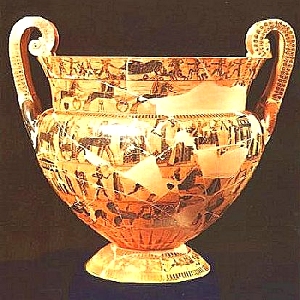
Etruscan Knowledge Institutions
During our unit on oral knowledge, I discussed knowledge institutions within the Etruscan civilization here. Last week, I talked about Etruscan writing and language here. This week, my assignment is to talk about knowledge institutions within the Etruscan civilization, as a part of our unit on written knowledge.
Tuesday, October 18, 2011
The Origins of the Alphabet, Phoenician Style
In the beginning, there were Egyptian hieroglyphs and Mesopotamian cuneiform. From that sprung the 22-letter Phoenician alphabet that is the Mother of every other alphabetic system known to man.

Monday, October 10, 2011
Choices, Choices! #1 - Children’s Stories, From Africa to Mulberry Street
I hope that over the course of today, I will be able to add the other two blog posts that I hope to write, and you can pick which one you would like to comment on (though if you are feeling adventurous, you can comment to all three). The other two will be a response to Dr. Burton's post on Syllabi and a commentary about my interview with an Ancient Near Eastern Studies Professor on the Phoenicians. I am excited to write them and share my experiences, and I hope you enjoy reading.
This past Friday, I did something atypical, and got a few
strange looks because of it. I attended
the weekly Storytime at the Museum of Peoples and Cultures, and learned about
the role of spiders in African and Caribbean folklore. The other patrons at the event were mothers
and grandmothers of toddlers, and of course the children themselves. After the stories, we made our own spiders by
tracing our hands without our thumbs and I helped a mother of 3 cut out her son’s
paper hands. It was a neat experience
for me, and something I would like to repeat.
Epic Performance

Imagine yourself high up in the mountains of present day Guatemala in a stone courtyard or plaza adorned with statues and figures carved from stone of fierce warriors, majestic kings and intelligent priests. The spoken words of a poet drift to your ears through the crisp air typical of the dry season. You listen attentively, relishing in the glorious detail of brave warriors and fierce battles. A part of you stirs in pride for your ancestors and rich cultural history.
Saturday, October 8, 2011
Talking with the Past. My interview
For my interview I decided to carry on the theme I started in my first post on the Khmer, so I talked to a eastern studies Professor and to a survivor of the Khmer Rouge. For my brief summary of Cambodian History and the distinction between the Khmer and the Khmer Rouge click here.
Thursday, October 6, 2011
A) True B) False C) Other
The last few weeks I have posted a bit about the Hopi and their oral history. First I gave a bit of an overview of their beliefs and then I posted more about their story and legends of how the Hopi people came to arrive here. This week I want to talk a little more about how these stories are passed on and may evolve over time. The picture below is of some Hopi kachina dolls. Kachina in the Hopi tradition are spirit beings that represent anything in the natural world or in the cosmos. They are said to have power over the many elements.
 |
| Hopi Kachina Dolls |
Wednesday, October 5, 2011
Oral Education and the Etruscan World, part 2
Last week, I posted about education in the Etruscan world, based on my reading on the topic. Earlier today, I posted a bit about the process it has been
to try and contact someone for an oral interview this week. It was really a lot
more work than I planned to put into this class. However, something finally
came through!
Tuesday, October 4, 2011
Choral Recitation at gaming events

In class today, Mrs Burton came and presented on Choral Recitation. She is a Kindergarten teacher for special need children and taught us to all respond in unison to her questions. This is an effective way to teach things.
Obviously we are being clearly taught about our identity and how to spell C-O-U-G-A-R-S at sporting events. We therefore decided to classify them as important educational rituals.
Remember that as you visit your next football game!
Friday, September 30, 2011
Just one of those weird things we do.
Tomorrow morning, about half a million people will crowd into university testing halls and take the LSAT, the Law School Admissions Test. (I'm one of them.) But it got me thinking--the whole standardized test education system is kind of a unique institution. We do it a number of times in our educational careers You take the SAT and ACT when you are graduating from high school and starting college, the GMAT or GRE or LSAT or MCAT, depending on what you want to do after you finish your undergraduate degree. And those of us who grew up going to public schools took all kinds of standardized tests, from the time we were in the first grade.
 It makes sense, that we use this type of system in order to compare what is happening in educational systems across a very large country, but still, it seems like one kind of interesting aspect of the knowledge institution we are a part of. There's not really anything oral about the LSAT or other standardized tests, but the fact that our group was specifically assigned to examine education institutions this week made me think about it differently than I previously had. I wonder where it came from and whether or not any other civilizations have employed a similar one.
Thursday, September 29, 2011
The Travelers
In last week's post I introduced the native-american Hopi culture. The Hopi are a native-american people who currently live in the "four-corners" area of the United States (principally in Arizona). After talking just a bit with my sister who has done some research and has an interest in the Hopi, I also decided that I would like to learn more. I drove over to her house in American Fork and borrowed her copy of Book of the Hopi by Frank Walters which i mentioned last week. This past week I have been reading it and have learned a lot about the oral tradition of the Hopi people.
I will try to briefly summarize the basic oral history of the Hopi here. Basically, under the direction of the supreme Creator, Taiowa, his nephew, Sótuknang, and the Spider Woman created various worlds. Humans were then placed lived in the First World. When the people that lived there became corrupt and stopped living up to the purpose of their creation, the First World was destroyed by fire and only those who had kept the "door on the top of their heads" open were saved by entering a kiva and living with the ant people while the Second World was created. (The "door" is the soft spot that babies have and is symbolic of being spiritually in tune with with Sótuknang because it is the path of spiritual communication with him.)
 |
| This is the emergence symbol. It symbolizes Mother Earth and her enveloping arms. |
Wednesday, September 28, 2011
Oral Education in the Etruscan World
The Etruscan Civilization flourished in what is now Central Italy
from about 800 to 264 BC. While evidence would suggest that the Etruscans were
highly educated and productive in their scholarship, almost no evidence remains
of that scholarship in the form of texts or records. However, there is some
evidence that the Etruscans employed such practices as haruspicy and taught and
learned in special institutes, kind of like universities.

Tuesday, September 27, 2011
Phoenicia = Purple
The Phoenicians are famous in history for a variety of things - the invention of the "first" alphabet, their amazing purple dye, the cedars of Lebanon, and their great trading ships. However, oral histories and educational institutes were apparently not one of them. Or at least not any that we are aware of today, because although they invented a 26- and 22-letter alphabet system that simplified the Egyptian language, they kept their records mostly on papyrus, which decays over time. Though based on other aspects of their society, I will try and construct some understanding of what their education and oral tradition might have been like.
 |
| The Cedar is an important carry-over from ancient times, and is on the modern flag of Lebanon. |
Monday, September 26, 2011
Popol Vuh and the Mayan language

Subscribe to:
Posts (Atom)