For my Rosetta Stone project, I was in the Mesopotamian group (Phoenicia is in that area) and we had some difficulties with our language and writing form. I mostly worked with Catherine to create the first artifact, and so during the second part I took a back seat, and mostly worked as the liaison to the group that received our artifact. But the first artifact itself was hard enough.
To start with, one of our other group members had talked to a professor on campus that was fluent in Akkadian cuneiform, so he went and talked to him, and gave us a sheet of paper with the English phonetic syllables and the English translation of the Akkadian, but not the cuneiform. For that, he told us to go down to the Museum of Peoples and Cultures and look at the actual clay nail that it was written on. (Note: Akkadian is the language of the Babylonians around 2500 B.C., cuneiform is the script they used to write it down, and Babylonia was the civilization that Catherine studied.)
Showing posts with label Rosetta Stone. Show all posts
Showing posts with label Rosetta Stone. Show all posts
Tuesday, November 15, 2011

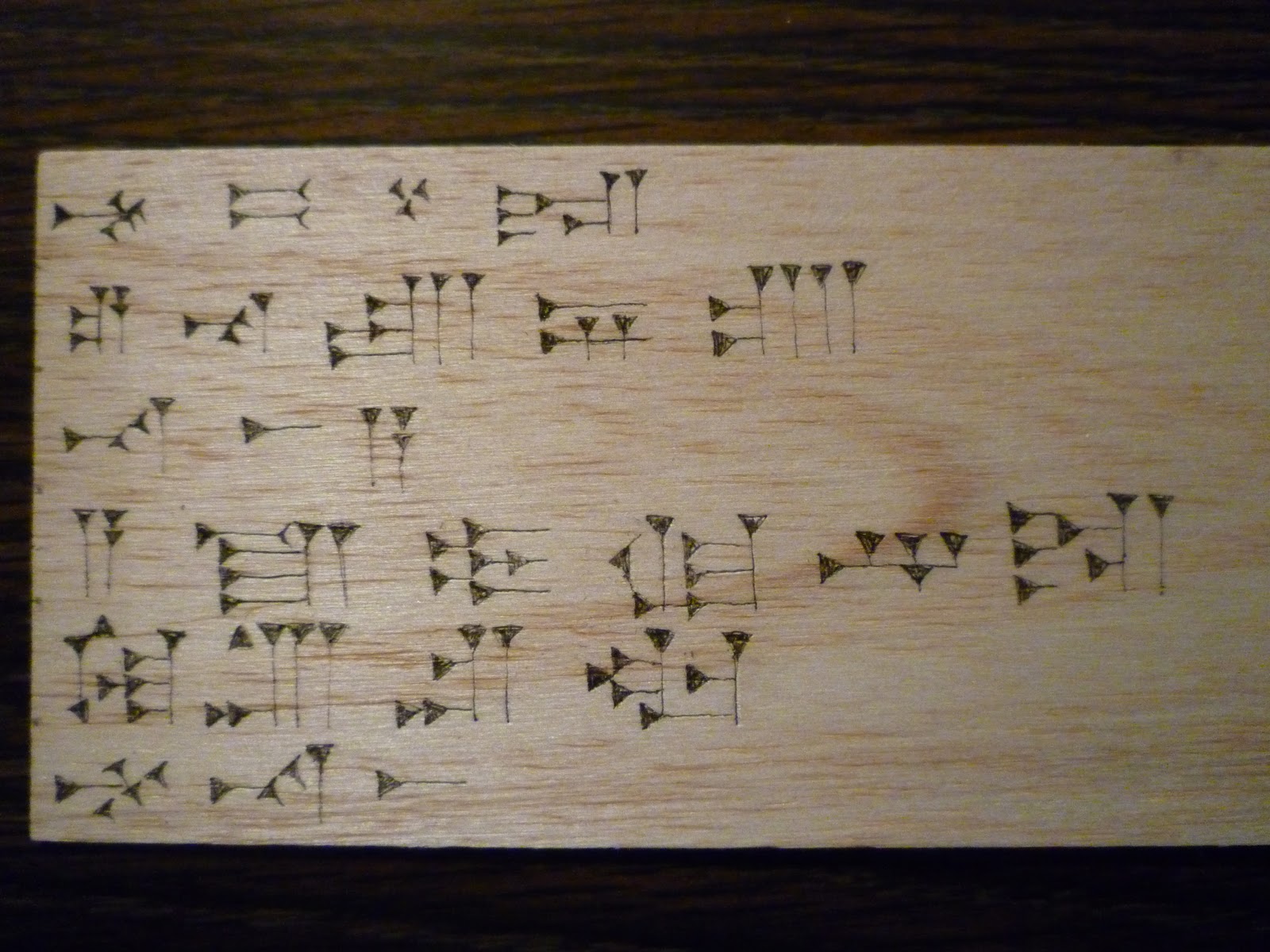
The Rosetta Balsa Wood


So the process after receiving our Akkadian clay tablet was a lot harder than anyone expected. A number of us started to try to find the characters and look up which syllables they represented independently. Luckily Erin was able to visit with a professor who gave her some more direction. It turns out that not all the characters were actually correct - revealing to us why it was no one could find a few of them. After translating all we could, we had to find the original document that the other group used in order fill in the gaps and get it translated to English ---------->
 I again was in charge of the Mayan translation which was difficult of course, because 1-Mayan is not completely deciphered yet 2: I am still shady on Mayan syntax and grammar 3: There are not equivalent words in Mayan, English, and Akkadian. This is something that I have realized as I have volunteered as a Spanish medical translator too. Sometimes things really are just "lost in translation," whether it is because of translator error, or meanings difficult to express in another language, copy errors, bias of a translator, or just plain laziness in translation. It is not an easy task.
This was a difficult assignment for MANY reasons but I really liked the idea of it and had fun learning about these mayan glyphs. I think that it really helped me understand how knowledge is passed on and how that really has changed from the age of writing to typing to the pixel. I also think this project helped us think creatively in order to solve problems that were completely unfamiliar to us.
Friday, November 11, 2011
The Chinese gift
 |
| Qufu |
Our first thought was to have a quote from Confucius on rice paper. This would have been culturally significant because paper was invented in China (see Shuan's post on this). However, attempts at making rice paper were disastrous. Contrary to popular belief, at least my own and that of my group members, rice paper is not actually made out of rice. It is made out of rice straw or more modernly wood fiber,, mulberry, or bamboo. Also the arguably most famous Confucius artifact is actually the Confucius temple of Qufu. Confucius sayings are inscribed in stone.
Going Mayan
 |
| Me trying out different inks with the sketches. |
Because this project is pretty time consuming, our group mostly split up into smaller specialty groups to get it done and so that we wouldn't be spending way too much time to finish the project. So I pretty much ended up as the Mayan language expert. The mayan language can be pretty daunting. Various dialects of Mayan are spoken today, but none quite like the ancient language. Modern Mayan is also written in regular Roman lettering like English, so trying to crack the code of Mayan glyphs was a pretty daunting task.
Rosetta Stone Project: Greece
This past week I had the opportunity to meet with members of the class who, like me, have been researching the role that oral and written traditions have in Greek culture. We discussed the various methods and materials that the Ancient Greeks used in order to record and write down their knowledge in order to help us come up with ways that we could create our own Greek "artifact."
Papyrus (a form of our modern day paper) was used in Ancient Greece, but the process of letting the product ferment takes weeks and we had limited time. (The fact that the bookstore does not sell papyrus may have played a role in our decision not to use it as well.)
Thursday, November 10, 2011
Mayan Glyphing Party

Subscribe to:
Comments (Atom)