Showing posts with label Michael Miles. Show all posts

Wednesday, December 14, 2011

Knowledge Exclusivity: A Swinging Pendulum


According to one of my old professors, diagrams with
triangles and circles are a key part to any presentation.
So here is a triangle diagram that illustrates exclusivity
with respect to knowledge institutions across time. 

As we have studied various types of knowledge institutions during the semester, we have come across various different patterns that transcended each of the different types of knowledge.  In our “salon” activity yesterday and while studying the different blog posts in preparation for the activity, I realized that one of the important trends in the knowledge systems was exclusivity and complexity of knowledge.  From folk knowledge to written knowledge, exclusivity increased, but then it came back full circle and is once again widespread with digital media.  After the move from folk and oral knowledge to written knowledge, the increased exclusivity and problems that accompanied it were the cause for a drive to increasingly widespread forms of knowledge systems.

Monday, December 12, 2011

Salon Notes


Ok so here they are.  My word vomit of notes for the salon tomorrow.  Feel free to take ideas or add to it if ya'll want.  I'm not going to repeat anything from Alicia's post since it's already written down, I'll just add my own personal thoughts on each of these categories.  HERE is the spreadsheet, just because it's fun to make, and

HERE --------------------------------------->

is a picture because posts are boring without them.

PS Just double click each box on the spreadsheet to read the whole text.

Tuesday, December 6, 2011

Draft of "Vesalius and the Press"

Hey guys.  I am posting this draft as a google doc.  Anyone can edit the document but please don't just delete things or I won't notice you did that, also make all comments with a different color of text please so they are easy to find.  Some questions I have are: does the intro sound too cheesy? Does my argument make sense and is it cohesive or does it sound too superficial?  I am still planning on putting a opposing viewpoint part in the conclusion paragraph or its own paragraph before it.  Any comments would be GREATLY appreciated.  (I realize that I did not put the citations at the bottom but I am going to work out the citations and formatting tomorrow)

Here's the LINK

Thanks

Monday, December 5, 2011

Frustration

So I have been in the library for a few hours and realized why I am not a history major.  History essays are really hard for me to write.  I feel like in other subjects you have to understand a concept pretty well to write an essay but for history you have to do 3 times as much research.  I am still trying to formulate my thesis statement.  I am thinking of doing something about either Vesalius that I referenced in my last blog post or maybe I will talk about the resurgence of popularity of the texts of the ancient Greek philosopher and physician Galen.  Or maybe both of them.  I am still figuring everything out.  Hopefully I will get it all figured out soon to post a thesis statement up here and get my draft done for tomorrow.  Otherwise it will be a late night.  Any insight would be much appreciated.

Thursday, December 1, 2011

On the Fabric of the Human Body


Who has ever heard of Andreas Vesalius?  Most of you probably haven't.  But I am sure that every one of you has benefited from his work.  While I was doing research last week for my annotated bibliography on print and medical knowledge, I ran across a lot of information on this guy, Andreas Vesalius.  Vesalius is known as the father of modern anatomy and was able to make such a huge impact on our modern knowledge of the human body specifically because of the printing press.  Vesalius published his great work De Humani Corporis Fabrica (On the fabric of the human body) almost a hundred years after the Gutenberg's invention of the printing press but it still was a huge step forward for the medical revolution.  I was pretty impressed by all of the pictures that were printed in his book, so I wanted to post a number of them here to show the great detail and complexity of the body that the printing press allowed Vesalius to show the world.

Thursday, November 24, 2011

Print and its Effects on Medical Advances

(So according to some suggestions by our professor I'm adding this note.  This post is part of my ANNOTATED BIBLIOGRAPHY assignment.  The bibliography is below the page break and is about THE EFFECTS OF PRINT ON MEDICAL KNOWLEDGE.)

*     *     *

Venturing into the strange world physical research in a library with actual books, moving bookshelves, and code-like numbers on the sides of these books can be a pretty scary task for today's college student.  I probably do about one or two research assignments in the library each semester, but I swear that each time a have I have to again overcome my fear of doing research and actual physical movement at once.  I also have to relearn how to look stuff up there every time I try to use the numbering system, which reminds me of the library card song from Arthur - An integral part of my childhood.  Please enjoy:


"Who's Dewey?": one of those questions we will never know the answer to. . . or maybe we could look him up on wikipedia.  Anyway, after getting reacquainted with the cataloguing system again, (which is actually not the Dewey Decimal System in the HBLL) I started to search for books that teach about how the printing press affected medicine.  So here it is:

Thursday, November 17, 2011

Corrected and Improved by the Author

 Today I took a visit to the Crandall Historical Printing Museum.  I wasn't really sure what I would find there so I just drove over and walked inside.  No one was at the desk so I wandered inside and I found a group of elementary school or middle school students inside on a field trip.  They must have been an LDS charter school or something and were listening to a presentation of how the first copies of the Book of Mormon were printed using the old printing presses and process.  I slipped into the back of the group and listened a bit.  The presentation was obviously more of an overview than technically historical so I wandered around a bit as I listened, examining the old presses and prints that the museum workers have made on them.  The tour guide said something that really caught my attention though.  He said that With the 37 signatures and setting the type and hand sewing the books together, the 5000 original copies of the Book of Mormon should have taken 2 years to produce working at full speed full time.  A miracle occurred and the books were printed in only 7 months by (if I heard him correctly) fairly inexperienced printers.

Tuesday, November 15, 2011

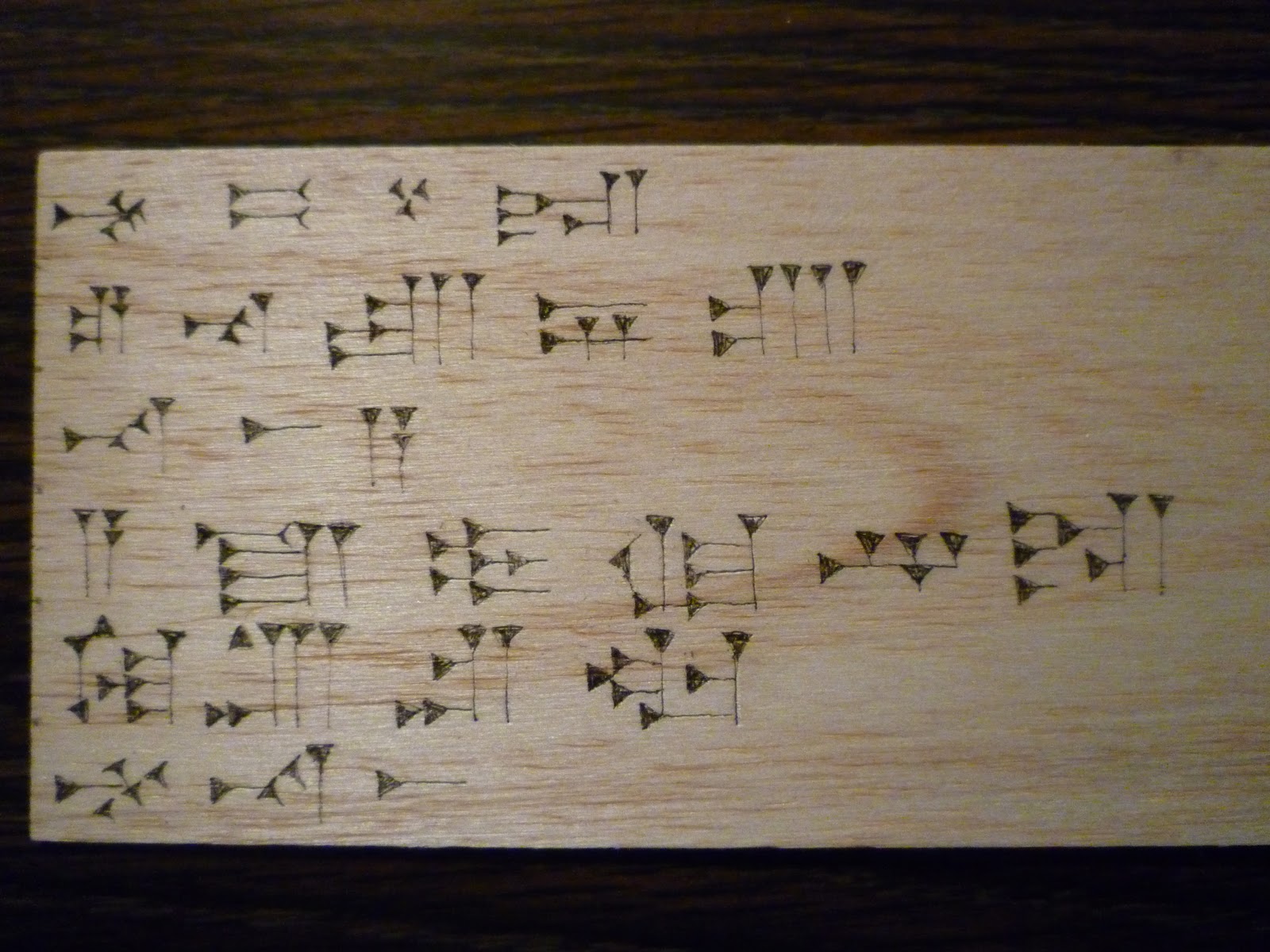
The Rosetta Balsa Wood

So here is the picture of our final product for the Rosetta Stone Project.  Yes that's right - you have here a sampling of modern English, Akkadian written in cuneiform, and some Mayan glyphs (you have to turn your head to read them by the way).

So the process after receiving our Akkadian clay tablet was a lot harder than anyone expected.  A number of us started to try to find the characters and look up which syllables they represented independently.  Luckily Erin was able to visit with a professor who gave her some more direction.  It turns out that not all the characters were actually correct - revealing to us why it was no one could find a few of them.  After translating all we could, we had to find the original document that the other group used in order fill in the gaps and get it translated to English ---------->
 

 With that done, Holland and Brianne headed up the artistic process (with Will's help and materials of course) of getting the cuneiform written on our "wood paper." This also proved to be very difficult because the ink bleeds easily in the porous wood.  They ended up having to use a SUPER fine pen to get everything to fit as small as possible.

I again was in charge of the Mayan translation which was difficult of course, because 1-Mayan is not completely deciphered yet 2: I am still shady on Mayan syntax and grammar 3: There are not equivalent words in Mayan, English, and Akkadian.   This is something that I have realized as I have volunteered as a Spanish medical translator too.  Sometimes things really are just "lost in translation," whether it is because of translator error, or meanings difficult to express in another language, copy errors, bias of a translator, or just plain laziness in translation.  It is not an easy task.

This was a difficult assignment for MANY reasons but I really liked the idea of it and had fun learning about these mayan glyphs.  I think that it really helped me understand how knowledge is passed on and how that really has changed from the age of writing to typing to the pixel.  I also think this project helped us think creatively in order to solve problems that were completely unfamiliar to us.

Friday, November 11, 2011

Going Mayan

Me trying out different inks with the sketches.
Will and I are in the same group for the Rosetta Project so he made a wonderful post about the process of creating our rosetta thing.  He pretty much summed up that whole process so I won't add much to what he said.  I instead wanted to blog a little about the process of coming up with the writing that we were going to use.

Because this project is pretty time consuming, our group mostly split up into smaller specialty groups to get it done and so that we wouldn't be spending way too much time to finish the project.  So I pretty much ended up as the Mayan language expert.  The mayan language can be pretty daunting.  Various dialects of Mayan are spoken today, but none quite like the ancient language.  Modern Mayan is also written in regular Roman lettering like English, so trying to crack the code of Mayan glyphs was a pretty daunting task.

Thursday, November 10, 2011

Scripts and Fonts

I think that this week for everyone is a pretty crazy one.  I am going to do you all a favor by trying to keep this short (and to do myself a favor too).  Since we just barely switched over from written knowledge to print, I thought I'd make sort of a bridge post about the transition and its effects on the way we write.

Compare these two writing samples.
A sample written script.

Sample font from Gutenberg's Bible

Obviously not all written things are that hard to read and not all print was that detailed and beautiful, but that is just an example.

A few weeks ago I got a random email from FamilySearch about indexing.  (Family Search indexing is a way that anyone can give service by transcribing old written documents into electronic type so that they are readily searchable for people studying their genealogy.)  The email linked me to a few sites about paleography which got me thinking about the differences between our letters today and the letters of 'back then' and the way that print changed that.

Thursday, November 3, 2011

ABRACADABRA

The word abracadabra - in it's earliest
known use - was written in this
 pattern and worn around the neck
 or sewn into clothing in order to cure fever.
In our class on tuesday, we talked about the occult in the history of knowledge.  The discussion really sparked my interest (just as anything I don't know much about piques my curiosity).  Coincidentally, another professor in my religion class a few days ago mentioned something interesting.  He talked about the possible origin of the word abracadabra.  Although there are many different ideas as to where the word came from, many believe that the word originates from the Aramaic for "I will create as I speak" or possibly from the Hebrew words "ab" (Father) "ben" (Son) "ruach hakodesh" (Holy Spirit).  Maybe it as a stretch but we might also interpret the general idea as the Father creating through his Word - "I the Father will create by my Word".  Interesting stuff.  It might change the way you feel about the next children's magic show you see or maybe you will think twice before saying what may have been at one point in time a very sacred phrase.

Thursday, October 27, 2011

Chicken ScratchERS

Yesterday, I was doing some research on the internet about different forms of writing.  I realized that everyone seems to have their own sort of writing utensil that they like to use.  Personally if it is not a Cristal Bic* (preferably black) or at least Bic* mechanical pencil, I am just not going to be a happy writer.  Well this got me thinking about how much we've seen about writing character systems and what we write on, but we hadn't looked a lot into what we write with.  So I decided to compile a short history of writing utensils leading up to the renaissance.

Chicken Scratch

 All right, so today I am going to put up two posts and this one will be short.  I was thinking about what I would blog about this week when I realized that my room mate's girlfriend had a set of calligraphy pens.  I figured that there would be nothing like a hands on experience with something that most of us are completely unfamiliar with today.  I started messing around and wrote this page (albeit somewhat sloppily) just to try my hand at writing with the metal tipped ink pen.


Thursday, October 20, 2011

Scraping Metal

This golden disk found in Peru is an contains
an inscription of a calendar system.
A few months ago they played a special on the Discovery channel about  discoveries of America before Columbus.  After talking about various theories about who were actually the first people to travel to the New World, they came to the conclusion that pretty much everyone discovered America at one point in time.  They finally changed their question from "Who discovered America?" to "Who didn't discover America?".  Well today I am not going to talk about the discovery of America but the making of metal books.  To those of us who are LDS (such as members of our Reinventing Knowledge class here at BYU) metal plate writings might be of special interest because the Book of Mormon was translated from an ancient record engraved on golden plates.  Although engravings on metal plates were at one point thought of as a rare occurrence, recent discoveries have shown more and more examples of this form of information storage.  As you will see in this post, we might pose ourselves a similar question:

"Who didn't write on metal plates?"

Thursday, October 13, 2011

Sitting on the Fence . . . For Thousands of Years

As we began this unit on written knowledge, I was rather excited.  I love hand writing and different symbols and everything that has to do with writing.  The power of the written word is something I have loved ever since I learned to read.  I suddenly became disappointed when I realized that I needed to talk about writing within the Hopi culture, mostly because they do not have an alphabet.  I guess that kind of puts a damper on writing if you don't have an alphabet.  Luckily as I have studied out the topic, I have realized that the Hopi language and people can give us a lot of cool clues as to how writing systems are developed because they stayed with a transitionary step to developing writing systems - the pictograph.
The famous "Hopi Prophecy Rock" - Said to depict
the consequences of not living in harmony
with the earth.  Says that if we don't there will be a
WWIII-like cataclysmic event. 

Thursday, October 6, 2011

A) True B) False C) Other

The last few weeks I have posted a bit about the Hopi and their oral history.  First I gave a bit of an overview of their beliefs and then I posted more about their story and legends of how the Hopi people came to arrive here.  This week I want to talk a little more about how these stories are passed on and may evolve over time.  The picture below is of some Hopi kachina dolls.  Kachina in the Hopi tradition are spirit beings that represent anything in the natural world or in the cosmos.  They are said to have power over the many elements.

Hopi Kachina Dolls

Thursday, September 29, 2011

The Travelers

In last week's post I introduced the native-american Hopi culture.  The Hopi are a native-american people who currently live in the "four-corners" area of the United States (principally in Arizona).  After talking just a bit with my sister who has done some research and has an interest in the Hopi, I also decided that I would like to learn more.  I drove over to her house in American Fork and borrowed her copy of Book of the Hopi by Frank Walters which i mentioned last week.  This past week I have been reading it and have learned a lot about the oral tradition of the Hopi people.

This is the emergence symbol.
It symbolizes Mother Earth and her enveloping arms.
I will try to briefly summarize the basic oral history of the Hopi here.  Basically, under the direction of the supreme Creator, Taiowa, his nephew, Sótuknang, and the Spider Woman created various worlds.  Humans were then placed lived in the First World.  When the people that lived there became corrupt and stopped living up to the purpose of their creation, the First World was destroyed by fire and only those who had kept the "door on the top of their heads" open were saved by entering a kiva and living with the ant people while the Second World was created. (The "door" is the soft spot that babies have and is symbolic of being spiritually in tune with with Sótuknang because it is the path of spiritual communication with him.)

Thursday, September 22, 2011

A Peaceful People

The Three Hopi Mesas in the Distance
 In this week's post, I've decided to leave the Aztecs for a bit and move a little bit north.  From Mexico to Arizona and New Mexico with the Hopi Indians.

I wanted to learn some more about ethics and moral beliefs in other cultures so I talked to my sister and her husband who have had a longstanding fascination with American Indians.  They are especially interested in the Hopi Indian tribe, who are one of the oldest peoples in America.  Because of time, my sister could only tell me briefly about a trip that she and her husband made not too long ago to visit the Hopi people and talk with some of their leaders.

Monday, September 19, 2011

Week Without Wind

When we were given the assignment to teach a skill I was way excited.  I went and borrowed my sister's trainer kiteboarding kite in order to teach a friend how to fly it. 


Well after a week of waiting for the wind that never came, I ended up teaching a friend how to crochet on an intensely exciting sunday afternoon.

Thursday, September 15, 2011

A Whistle to Carry You Home

WARNING: THIS POST MAY GIVE YOU NIGHTMARES!

     So as I have been researching about ancient cultures I have become fascinated with the Aztec Empire of Mexico.  Last week I talked a little bit about the medical practices of the Aztecs and other pre-colombian cultures.  Sadly, not even modern medicine has advanced enough to let us live forever and death is inevitable for us all.  I stumbled across a video on the internet that freaked me out and intrigued me enough that I decided to investigate some more about Aztec beliefs about the passing from this world to the next.  Before showing it though I need to explain a little first.

     
Quetzalcoatl and Mictlantecuhtli (god of the underworld)