So, for thanksgiving I got to go to my sister's wedding in Hong Kong. I notices several things that we had mentioned in previous blog posts or comments that I took pictures of and thought would be good to pass on to you all.
Showing posts with label Printing. Show all posts
Showing posts with label Printing. Show all posts
Tuesday, November 29, 2011

Monday, November 28, 2011
Annotated Bibliography: Censorship in Elizabethan England
For
my annotated bibliography assignment, I decided to learn a little bit about censorship
in Elizabethan England. Censorship is a topic that I’m very interested in, but
it’s such a huge topic that I wouldn’t have known where to start if I was just
researching anything to do with it, so I wanted to narrow it down somehow. The
Tudors made for some of my favorite English royal drama, Elizabeth I is one of
my favorite people, and Shakespeare was producing his work during the
Elizabethan and Jacobean (Stuart) Eras, so I decided to learn everything I
could about censorship in the Elizabethan Era. There weren’t very many books on
that specific topic, but I was able to find several books in the library in
which the issue was at least addressed on some level, and I used interlibrary
loan to have a few other books sent over.
Print Distribution and Dissemination.
As you can tell from my previous blog posts, I am intrigued by the idea of printing and how it affected society today. I'm grateful that Johannes Gutenberg invented the printing press during the Renaissance Era, because it changed how people back then and even still today receive and distribute knowledge. Without it, the education system, the legal system and many other aspects of society today would be completely different and would most likely be more oral based and involve a great deal of memorization.
To show my appreciation for print, distribution and dissemination during the Reniassance Era, I decided to do some investigating on this subject. I searched the Harold B. Lee Library and made my way to the fifth floor to scope out some books on the topic.
Visiting the Crandall Historical Printing Museum

Thursday, November 17, 2011
Corrected and Improved by the Author

Tuesday, November 15, 2011
To Fold or Not to Fold? That is the Publisher's Question
If you have studied Shakespeare even a little bit, you should have been exposed to the idea of folios and quartos, not to mention octavos or thirty-twomo's. If not you are about to be educated.
 |
| A thirty-twomo (its a book size :-) |
Saturday, November 12, 2011
Bring out the Money

Friday, November 11, 2011
Printing and Digital Media.
The printing press, which I talked about in a previous blog post, made it possible for literature to be mass produced at a quicker rate that was less expensive. It provided the common people of the Renaissance Era the opportunity to own books and read what great scholars where discovering and learning all over the world. But that's just it...printing allowed GREAT SCHOLARS and WELL KNOWN FIGURES to promote their ideas.
People like John Locke, Martin Luther and Voltaire were able to express their revolutionary ideas. John Locke, for example, promoted a more liberal philosophy which is considered a "keystone" to American government and other Western countries' governments. Martin Luther was considered the father of the Protestant Reformation, which taught people to break away from the traditional teachings of the Roman Catholic Church and taught that it was through the grace of God and one's own faith that one could be saved. Voltaire, another prominent figure (writer) of the Renaissance Era who advocated freedom of religion, free trade, and separation of church and state.
 |
| Gutenberg Press |
Thursday, November 10, 2011
Scripts and Fonts
I think that this week for everyone is a pretty crazy one. I am going to do you all a favor by trying to keep this short (and to do myself a favor too). Since we just barely switched over from written knowledge to print, I thought I'd make sort of a bridge post about the transition and its effects on the way we write.
Obviously not all written things are that hard to read and not all print was that detailed and beautiful, but that is just an example.
A few weeks ago I got a random email from FamilySearch about indexing. (Family Search indexing is a way that anyone can give service by transcribing old written documents into electronic type so that they are readily searchable for people studying their genealogy.) The email linked me to a few sites about paleography which got me thinking about the differences between our letters today and the letters of 'back then' and the way that print changed that.
Compare these two writing samples.
 |
| A sample written script. |
 |
| Sample font from Gutenberg's Bible |
Obviously not all written things are that hard to read and not all print was that detailed and beautiful, but that is just an example.
A few weeks ago I got a random email from FamilySearch about indexing. (Family Search indexing is a way that anyone can give service by transcribing old written documents into electronic type so that they are readily searchable for people studying their genealogy.) The email linked me to a few sites about paleography which got me thinking about the differences between our letters today and the letters of 'back then' and the way that print changed that.
Tuesday, November 8, 2011
Marginalia: Facinating or Defacing?
Marginalia: marginal notes or embellishments (as in a book). Latin.
Love,
Webster
Love,
Webster
 |
| Marginalia of The Lion, The Witch and The Wardrobe |
Friday, October 28, 2011
Printing.
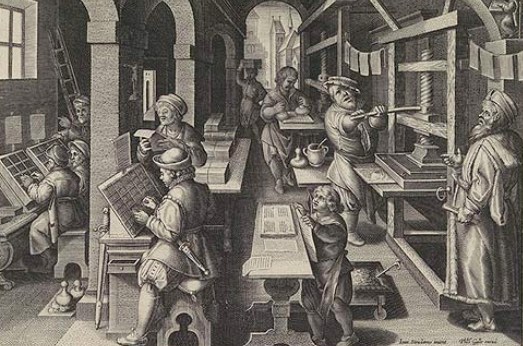
The first printing press was invented during the Renaissance era around 1440 by Johannes Gutenberg of Mainz. This printing press used a movable metal type which was set to print one page of a book at a time. Oil-based inks were used to coat the type. After so many copies were made of one page, the type would be cleaned and rearranged to form the next page, until all of the pages of a book were complete.
 |
| Johannes Gutenberg |
(which was also used for printing images), as it was molded of metal and would not crack or break as easily. The type was also more uniform and easily read, unlike written writing which was often times corrected by multiple people with different hand-writings. The type could also be adjusted or created to be more aesthetically pleasing and appealing to the eye. Often, art was also inserted into books through printing as well. Oil-based ink was used because it was long-lasting and would not fade as much.
Because books and other written works were able to be printed quicker and through mass production, the price of books became cheaper and became more available to the common people. The most famous of these mass produced texts, the Bible (or the Gutenberg Bible), was most commonly read more than any other book during this time.
 |
| Gutenberg Press |
With this new found way of mass producing written works, the printing press popularized all throughout Europe within only a few decades. This allowed for scientists, religious leaders, and other scholars to circulate their ideas and discoveries quicker and on a much broader scale that was available to the middle class as well.
This method of printing and distributing of knowledge continued until the 19th century when the hand-operated Gutenberg press was replaced by the steam-powered rotary press and, eventually, computer printers.
Subscribe to:
Posts (Atom)